Litentry: Aggregated Digital Identity on the Blockchain




The Internet is changing our perception
The speed of social development is affected by the speed of knowledge dissemination. And every change in the direction of social development is a change in the consensus of all mankind. The earliest way of information dissemination is decentralized, and people spread knowledge through word of mouth. It was not until Gutenberg and Bi Sheng invented the practical movable type printing that knowledge could be disseminated on a large scale through paper books, and it continued until the emergence of the Internet.
Humans once thought that the Internet represented the most advanced era, where knowledge could be spread quickly and freely without cost, which greatly increased the speed of social consensus formation. However, Internet giants carve up users and information, turn them into their own moats, filter information, indulge third parties to create false data, and forcibly add subjective intervention to human knowledge bases, misleading the formation of social consensus.
Are the likes we see real? Are the search results what we want? Is the pushed algorithm public? Are platform verified experts really trustworthy?
Based on decentralized technology, Web3.0 technology, known as the next generation Internet, has brought us opportunities and challenges to change this status quo. Blockchain technology provides credible information, but the distribution of this information is discrete and irrelevant. In order to improve the speed and breadth of social consensus formation, it is also necessary to create a system of information collation and induction from different dimensions.
And this kind of system must be open and transparent, so as to ensure that it will not be affected by any subjective factors, such as power and economic interests; it must be scalable, because the boundaries of cognition are constantly expanding, and so are the methods of cognition. Constantly changing, even circuitous; must be open, Foucault said that maintaining individual independence and particularity is the basis of cognitive evolution, we allow any organization and individual to submit their own unique cognitive methods.
In social networks, identity is the source of people's cognitive system, which is related to how to recognize each individual and how to evaluate each individual's behavior and thoughts. Litentry hopes to use the power of technology, starting from the blockchain, to provide a decentralized, renewable and open (trustless) individual identity recognition system to improve the speed and breadth of social consensus.
secondary title
Identity Problems in Real-World Networks
An identity is a collection of data about a person on the web. Without our knowledge, our data is often collected by some applications and scripts, handed over to some data intermediaries, marked and sold to advertisers for profit. This not only leaks personal privacy, but also changes the content and sorting of our browsing interface, affects our perception of things, creates an "information cocoon", and narrows the boundaries of our cognition.
On a semi-anonymous network such as the blockchain, the user's address does not represent any information, which can well protect our data from being marked and collected, but it lacks the aggregated digital identity brought by Web2.0 benefit.
A cross-platform identity can provide users with great convenience when using different customized services.
For example, Alipay’s Zhima Credit generated by analyzing payment data allows users to rent without a deposit and obtain services such as microcredit loans. At the same time, a cross-platform identity such as WeChat login can easily log in on multiple platforms, and conveniently authorize and verify identity data.
Therefore, different wallets of the same identity lack connection with each other and become "information islands", making it difficult to realize cross-platform identity login calls, and it is also difficult to generate valuable information to form an individual identity recognition system.
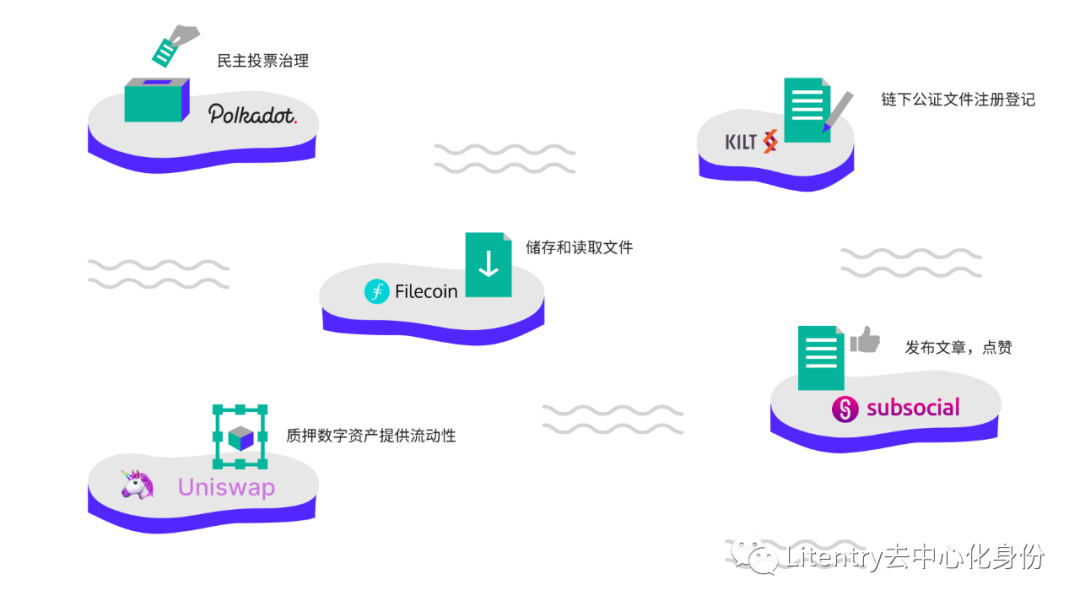
image description
["Information islands" are formed between different blockchains]
The impact in the field of DeFi (decentralized finance) is that we still lack credit-related products.
Now users must provide certain collateral in order to obtain loans. However, credit payments and loans account for a large proportion of payments in real life, and even many products can only be purchased through credit payments. If identity credit is implemented in the blockchain network, a large number of financial products can be spawned.
Not only that, the lack of individual identity recognition system has a fatal impact on Web3.0.
In the era of paper, author/title/university/publisher/newspaper constitutes a complete certification system. Sir Isaac Newton published "Mathematical Principles of Natural Philosophy". Is Newton's theory correct or wrong?
The title of President of the Royal Society tells people that Newton was right, and countless great minds also said that Newton's theory is perfect, and that individual credit is promoting the formation of consensus, and the spread of correct knowledge determines the development of society direction.
How can a reasonable cognitive system be produced in the world of Web3.0?
Therefore, we must integrate as much trusted information as possible in the existing Web3.0 network to create an aggregated digital identity that is not limited to any blockchain. Such an aggregated digital identity will eventually surpass the cloud identity on Web2.0, cross-platform identity, and realize a comprehensive individual identity recognition system.
secondary title
In our blockchain network today, the foundation for creating an aggregated digital identity has slowly been laid. Because our current transactions are not limited to transfers, but more new types of transactions have been generated through DeFi and on-chain governance, revealing more user information.
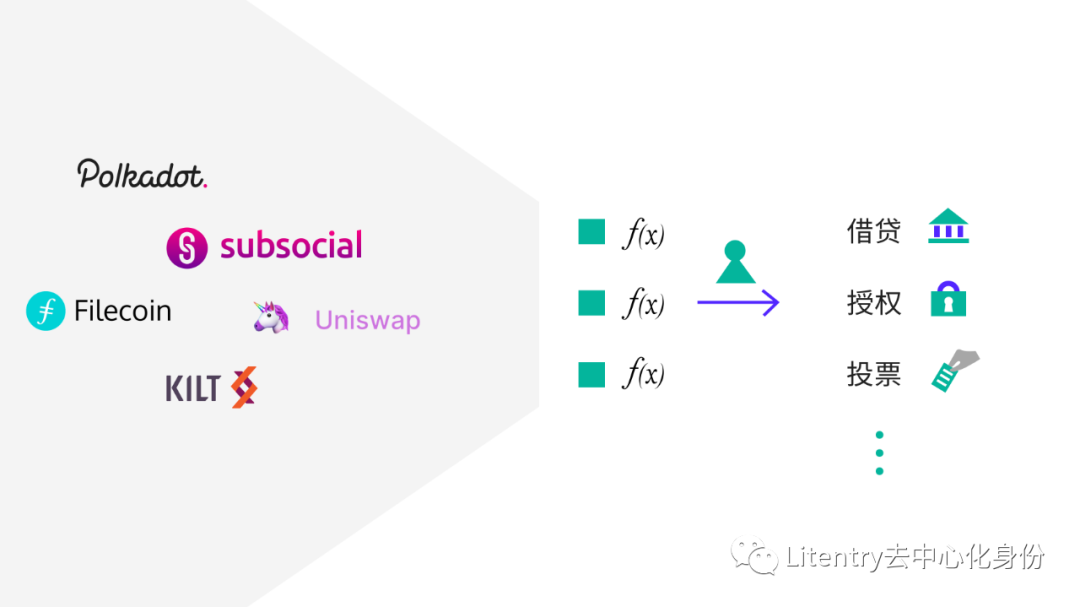
image description
[Litentry uses cross-chain data to aggregate digital identities]
For example, by obtaining and analyzing the records of users providing and withdrawing liquidity in Uniswap, we can know whether a user is a long-term liquidity provider. For example, by querying and analyzing a user's voting records on Polkadot, we can know whether he is an active participant in on-chain governance.
This is why transactions on Polkadot are also called Extrinsics (external information), because it means a piece of information from outside the blockchain that changes the state inside the blockchain. Therefore, after combining information from different perspectives on different blockchains, we can often obtain some more valuable information. The aggregation of these information also makes the user's digital identity more rich and three-dimensional, which is what we call aggregated digital identity.
secondary title
The concept of Litentry
Litentry is committed to building the basic framework and network of the individual cognitive system on the basis of the existing blockchain. Anyone can combine personal information in different blockchain networks in Litentry, and can also build a series of identity evaluation algorithms to generate an aggregated and quantifiable identity through calculation based on the information on different chains of the user. , Cross-chain digital identity. And the digital identity provided must be:
Open: In our daily banking system or on large platforms like Alipay, identity credit and rating data are calculated by banks or platforms, and are centralized. Any node can join the network, and anyone can upload their own evaluation algorithm without additional authorization. The capture of data is realized through different nodes in the blockchain network. The source of data is decentralized. Nodes compare the results of consensus calculations to ensure the reliability of the source and realize the function of an "identity oracle".
Scalable: The algorithm itself can be updated and changed through community consensus, such as changing or adding or deleting parameters, changing the source of data, and allowing the algorithm provider to earn income. The quantitative information of identity is also the result of real-time calculation based on the latest algorithm.
secondary title
Building a network based on Substrate
Litentry's aggregated digital identity is built on substrate and will be connected to the Polkadot network in the future to become a parachain.
Polkadot has the characteristics of cross-chain, so can you use a Polkadot wallet directly in different networks?
First of all, in the Polkadot network, the same pair of keys is also called a wallet, and the SS58 address information generated in each network is different because of the different encoding methods. Theoretically, users can use the same wallet in different parachains, but this is like using the same account and password to log in to different apps, which is very insecure. So the best way is to generate a separate wallet for each network, which is how Parity Signer manages identities and wallets.
Another reason is that no matter now or in the future, there may be many blockchains that are not connected to the Polkadot ecosystem and have not become a parachain. Litentry's "identity oracle" mechanism can be connected to any blockchain network, not just the parachain in Polkadot. Even in the future, some off-chain account information such as LinkedIn and Twitter can be imported into the system.
There is a native identity module in the Polkadot system, why not use this module directly but create a separate parachain?
A parallel chain can flexibly design its own economic model and create an effective incentive mechanism to encourage users to connect identity information on different chains together.
The existing identity module on Polkadot is used to provide basic identity data for on-chain governance. This module still has problems such as the high Gas fee, the need for off-chain manual communication, and the lack of standard verification procedures. On Litentry, all verification and query processes are completed on the chain through network consensus.
As mentioned in the previous question, as a parachain, Litentry not only provides a cross-chain identity for Polkadot ecological projects, but also can be combined with all blockchains and even off-chain platforms that are not connected to Polkadot to realize Provide identity services for the entire Web3.0 ecosystem.
secondary title
Application of Aggregated Digital Identity
With such digital identities aggregated from different chains, the application range of existing blockchains can be profoundly expanded, such as:
The calculation of voting weight is diversified. The voting weights of different resolutions can have different calculation mechanisms, which expands the dimension of voting and the dimension of blockchain applications. For example, the voting weight can be determined through the user's participation record in DeFi, so that an active DeFi participant can obtain greater voting power when making relevant decisions.
Customized services. Aggregated digital identities can be customized in various on-chain applications. For example, if a new blockchain project confirms that a certain user was once a validator (Validator) of another network, then some airdrop digital assets can be given to this user to attract him to participate deeply. For another example, a new Defi product can provide some initial discounts to users of previous similar products.
Diverse application scenarios. Aggregated digital identities can realize credit inquiry, identity authorization and authentication, and can also realize functions including single-account multi-chain login and agent payment.
Combined with off-chain applications. For example, the data in LinkedIn and Twitter expand the dimensions and application scenarios of aggregated digital identities.
Litentry innovatively proposes the concept of aggregated digital identity, which complements the missing part of the blockchain semi-anonymous network and will become an important infrastructure in the Web3.0 network, creating a transparent, scalable and open individual identity recognition system.
Welcome everyone to pay attention to our official account. For more information, please visit our website Litentry.com. For more information and technical introductions on aggregated identities, we will publish a series of articles one after another:
"Cross-chain digital identity based on Substrate"
"Cross-chain identity agent login and payment function"
Website: litentry.com
Medium: litentry.medium.com
Telegram: t.me/Litentry
Twitter: @litentry
Github: https://github.com/litentry